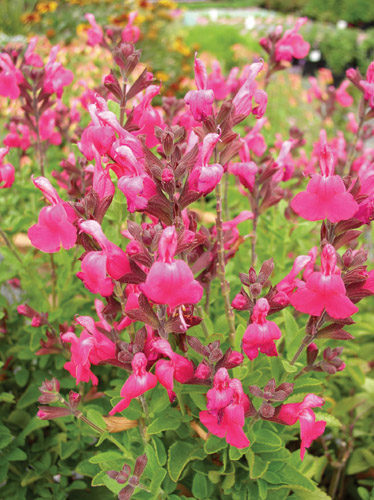
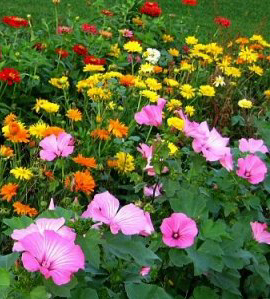
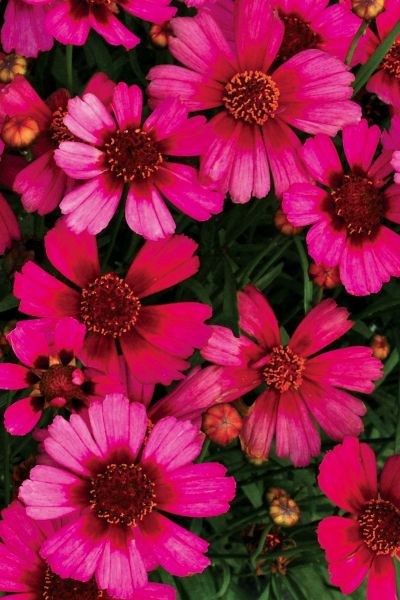
I fertilized our home’s landscape just as this week’s rain hit; talk about perfect timing! Monsoonal conditions offer an ideal time for a summer feeding. So, if your summer plants have not bloomed yet, their growth seems slow, their colors pale, or if you just want bigger shade trees and healthier natives, you can remedy these issues. Just get that plant food into landscapes within the next 2-3 weeks!
Many gardeners have asked me, “What do you use to feed your landscape, Ken?” This is my reply, simple and to the point: I use a special formula created just for our mountain landscapes, and, WOW, do plants love the taste! It was three years in the making, and I know because I developed it. Its cleverly appropriate name is ‘All Purpose Plant Food’ 7-4-4. This all-natural food is perfect on every plant in every yard. Lawns, trees, shrubs, flowers, container gardens, and roses thrive on it. “All Purpose” is specific to our region, easy to use, difficult to make a mistake with, and a must for all our summer bloomers to look their best.
Here are some bits of advice when using fertilizer, whether synthetic or all natural:
- Don’t allow plant foods to remain on the foliage because those leaves can become spotted. Shake the leaves or hose off any excess that may settle on them.
- After applying this summer meal to lawns and flowers, be sure to run the irrigation. Do not let granular foods remain in the hearts of agaves and yuccas, as this can cause serious damage to the plants.
- The best placement of plant food is always at the outer edge of a plant’s drip line. If you’re not sure where to put your food, imagine that you are a tree, then fully extend your arms, and envision placing most of the plant food in the area from your elbow out to your fingertips. This comparable area under a plant is the location of most of the feeder roots, those fine root hairs designed to pick up food and water. It’s important to remember that roots directly under the trunk of a plant are unable to absorb plant food; they are there to hold up and support the plant.
With properly placed and thoroughly watered-in plant food, it won’t be long until our gardens are filled with blossoms!
~~ ~~ ~~ ~~ ~~ ~~ ~~
These are the summer days when homeowners are thankful for their shade trees. There is a direct correlation between leaf count of sheltering trees and the cost of cooling a home. Strategically placed trees can dramatically reduce the temperature of our homes. From a design perspective deciduous trees are placed on the south and west sides of a home or patio. From these placements they offer cool shade in the summer, and when they lose their foliage they allow the winter sun to warm those same structures.
Trees are the single most important investment of any landscape because they add value, comfort, and visual appeal to your home. Trees are once-in-a-lifetime investments for most homes as they can outlive their builders by hundreds of years. Mathematically it makes sense to reduce the number or size of your landscape shrubs, freeing up more of the budget to buy larger or better trees. Also, remember to upgrade the size of new trees for a mature look in a new landscape.
An ugly tree stays ugly for the life of that tree. So, do not settle for average sizes just to pinch a few pennies when it comes to your trees. Only put your money, sweat, and energy into perfect specimens. A broken branch from shipping is OK, but never accept trees with leaf spots, wilting, thin or wispy branches, or a root structure that is overgrown and root bound from being left in the pot too long. Each has a negative affect on any plant, but especially on trees. You do not want to spend your time nursing trees back to uncertain health.
~~ ~~ ~~ ~~ ~~ ~~ ~~
Shorter shade trees mature between 15-25′ and are useful as street trees, lining driveways, or as courtyard accents. They are recommended for smaller patio homes and for the backyards of town houses/ condos.
My favorite variety of this size tree is the Chocolate Mimosa. At first glance its beautiful chocolate bronze leaves appear to be large ferns. The scented clusters of powder-puff- pink blooms are attractive to butterflies and to humans. Stunning when gazed upon from an upper story deck, this fast grower also is the perfect ‘for sitting under’ front yard accent.
Wind becomes a factor for shade trees that mature at a height of 25 to 40 feet. Each has a nice structure with strong trunk and limbs that tolerate our unrelenting winds or winter snow without breaking. These moderate to fast growers adapt well to our heavy mountain soils, so allow them plenty of space to grow.
Right now in this category of trees there are so many great choices at garden centers that it’s hard to k now where to begin browsing. I suggest that you start by looking at the raywood ash, sunburst locust, autumn blaze maple, and the purple robe locust.
See our very own Arizona native, the desert willow, in bloom from Skull Valley to Dewey. Autumn Gold gingko, Flamingo box elder, and the Chinese pistachio also make great mountain choices. I bet that I could write a book about mountain trees!
Until next week, I’ll see you in the garden center.
http://wattersgardencenter.com/2013/plant-food-rain-thriving-gardens-healthy-trees/ Plant Food + Rain = Thriving Gardens & Healthy Trees